
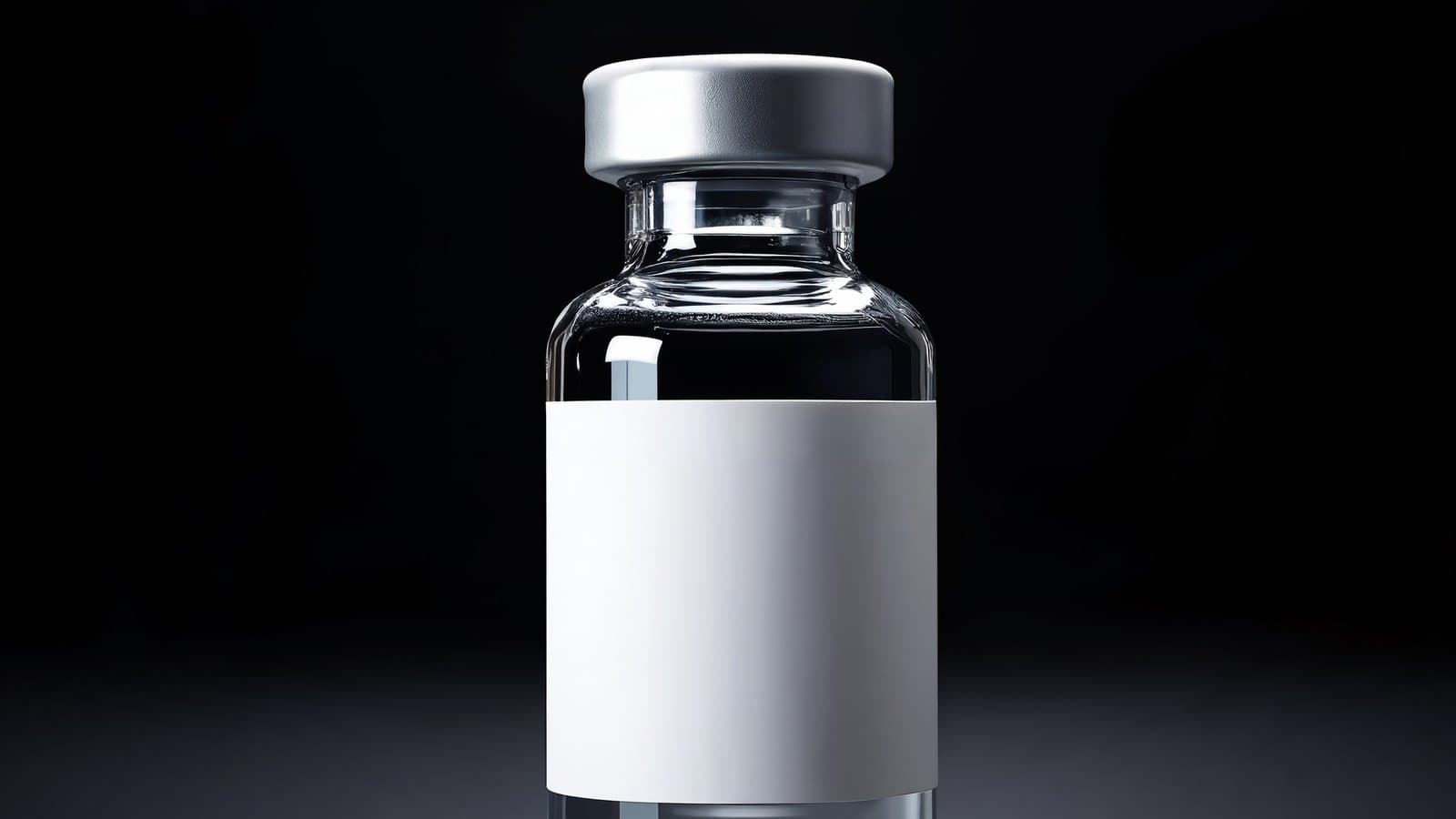
Two vials sit on a counter. One is small, with what looks like almost nothing in it — a white disc, or a film on the glass, or a scatter of powder. The other is larger and full of clear liquid. Between those two vials is a step almost nobody writes about properly, and it's the step I get asked about more than any other.
The asymmetry is strange once you notice it. There are thousands of pages explaining what a given peptide does — the receptor, the mechanism, the trial data, the history of the molecule. There is almost nothing on the material itself: what the clear liquid actually is, why it isn't just water, and what happens to the powder at the moment the two meet. The molecule gets all the attention. The handling, which is where things actually go wrong, gets a sentence.
So this article is about the material, not the molecule. How lyophilized peptides are put back into solution, what the diluent is and why it contains what it contains, how the ratio of powder to liquid determines concentration, what sterile handling actually consists of, and how long the result stays intact. It's laboratory technique — the same technique a compounding pharmacy or a research lab would use, written out properly for once.
One boundary before we start, because it shapes everything below. This is a handling guide. It covers material: how to keep a peptide chemically intact and microbiologically clean from the moment it arrives to the moment it degrades. It doesn't cover use in people, and it deliberately doesn't cover the questions that follow reconstitution. Those belong to a clinician, not to an article.
Why the peptide is a powder in the first place
Peptides are chains of amino acids, and in water they're fragile in specific ways. They hydrolyze — water attacks the peptide bonds. They oxidize, particularly at methionine and cysteine residues. They deamidate at asparagine and glutamine. And they aggregate, clumping into higher-order structures that no longer behave like the original molecule. Every one of those pathways is accelerated by having water around.
Lyophilization — freeze-drying — is the answer, and it's an elegant one. The peptide is dissolved, frozen, and then the ice is removed by sublimation under vacuum: it goes straight from solid to vapor without ever passing through a liquid phase. What remains is a dry, porous cake, typically with very low residual moisture, in which the degradation pathways above are dramatically slowed because their reagent has been removed.
That cake is what you receive, and it doesn't always look the way people expect. Sometimes it's a neat white disc at the bottom of the vial. Sometimes it's a thin film on the glass, or a scatter of powder that appears to have shifted in transit. Sometimes, in low-milligram vials, it's almost invisible — a faint frost you have to tilt against the light to see. None of those appearances is a defect on its own. A cake that broke up during shipping is still a cake. What matters is what happens when the diluent goes in.
And that's the moment worth sitting with. Reconstitution is where you undo the protection. You are deliberately putting the water back, which restarts every clock lyophilization stopped. Everything that follows in this article is about doing that carefully and then managing the time you've bought.
The three liquids, and why they are not interchangeable
Three clear liquids come up in this conversation. In a vial they look identical, and they are genuinely different products with different jobs.
Bacteriostatic water for injection
Bacteriostatic water is sterile water that contains an antimicrobial preservative — benzyl alcohol, most commonly at 0.9 percent, which works out to 9 mg per mL, though 1.1 percent presentations of the same product exist. Read the label rather than assuming; the strength tracks the container, and the same manufacturer supplies both. It is supplied in multiple-dose vials, commonly 20 mL or 30 mL, precisely because the preservative is what makes repeated entry into the same vial defensible.
The word to notice is bacteriostatic. Not bactericidal. Benzyl alcohol inhibits the growth of bacteria that find their way into the vial; it doesn't sterilize the contents, and it won't rescue a sample that's been contaminated through careless technique. What it buys is time against the small, statistically inevitable ingress of organisms that comes with puncturing a stopper more than once. That distinction matters more than almost anything else in this article, because a great deal of bad practice rests on treating the preservative as a disinfectant.
Benzyl alcohol also isn't pharmacologically inert — it's a preservative with its own profile, which is exactly why preservative-free diluents exist alongside it for applications where a preservative is unwanted. That's a decision for whoever is responsible for the application, not for a handling guide.
Sterile water for injection
Sterile water for injection is the same thing without the preservative: water, sterilized, nothing else. It's supplied as single-dose, and the logic of single-dose is strict. Once the stopper has been punctured, there's nothing in the vial inhibiting the growth of whatever entered with the needle. Compounding standards do assign an entered preservative-free container a beyond-use time, and the number is more alarming than "none": six hours if it was punctured in cleanroom-grade air, and one hour in anything worse. Outside a pharmacy, that means one hour. The convention is to use it and discard it, not to store it.
Sterile water is also hypotonic — it has no solutes, so its osmolarity is essentially zero. That's a property worth knowing about the fluid regardless of what it's being used for.
Sodium chloride 0.9 percent
Normal saline is isotonic — matched to physiological osmolarity — and it comes in both preserved and preservative-free forms, which is a distinction people routinely miss. Bacteriostatic sodium chloride contains benzyl alcohol and behaves like bacteriostatic water in terms of multiple entry. Plain 0.9 percent sodium chloride does not, and follows the single-dose logic above.
Saline isn't automatically a better or worse diluent than water. It changes the ionic strength of the resulting solution, and peptide solubility and stability are sensitive to ionic strength and pH in ways that are compound-specific rather than general. The honest statement is that the appropriate diluent is the one specified for the specific material, and that where a specification exists it overrides any general rule — including the rules in this article.
The ones that are not diluents at all
Distilled water, purified water, spring water, contact lens saline, and anything else that isn't labeled sterile and intended for injection are not candidates. Not because of some formality, but because sterility is a manufacturing property — it can't be inferred from appearance, and it can't be restored at the bench. Water can be spotlessly clean and still carry bacterial endotoxin, which survives conditions that kill the bacteria that produced it. This is one of the few places in this article where there's no nuance to offer.
The arithmetic: how the ratio sets concentration
Here's the part people brace for, and shouldn't. It's a single division.
Concentration equals mass divided by volume. The milligrams of peptide in the vial, divided by the milliliters of diluent you add, gives you milligrams per milliliter. That's the whole calculation.
A 5 mg vial reconstituted with 1 mL yields 5 mg/mL. The same 5 mg vial reconstituted with 2 mL yields 2.5 mg/mL. With 5 mL, 1 mg/mL. The quantity of peptide never changes — it was fixed at 5 mg the moment the vial was filled. All you're choosing is how dilute it is, which means all you're choosing is how much liquid volume corresponds to a given quantity of material.
Because peptides at this scale are quantified in micrograms as often as milligrams, the conversion worth memorizing is that 1 mg equals 1,000 mcg, so a solution at 2.5 mg/mL is also 2,500 mcg/mL.
A ratio reference
Working through the common vial sizes:
- 2 mg vial + 1 mL — 2 mg/mL (2,000 mcg/mL)
- 2 mg vial + 2 mL — 1 mg/mL (1,000 mcg/mL)
- 5 mg vial + 1 mL — 5 mg/mL (5,000 mcg/mL)
- 5 mg vial + 2 mL — 2.5 mg/mL (2,500 mcg/mL)
- 5 mg vial + 2.5 mL — 2 mg/mL (2,000 mcg/mL)
- 5 mg vial + 5 mL — 1 mg/mL (1,000 mcg/mL)
- 10 mg vial + 1 mL — 10 mg/mL (10,000 mcg/mL)
- 10 mg vial + 2 mL — 5 mg/mL (5,000 mcg/mL)
- 10 mg vial + 5 mL — 2 mg/mL (2,000 mcg/mL)
- 15 mg vial + 3 mL — 5 mg/mL (5,000 mcg/mL)
- 30 mg vial + 3 mL — 10 mg/mL (10,000 mcg/mL)
Note that 5 mg with 3 mL gives 1.667 mg/mL — a number that doesn't resolve cleanly. Ratios that produce round concentrations aren't more correct chemically, but they're much less error-prone arithmetically, and arithmetic under fluorescent light at eleven at night is where mistakes live. There's a reason people gravitate to whole numbers.
What a small volume of that solution contains
Once you know the concentration, any volume of the solution has a defined content. Graduations on a fine-scale syringe marked to 100 units per milliliter correspond to 0.01 mL each. So:
- At 1 mg/mL, 0.01 mL of solution contains 10 mcg
- At 2 mg/mL, 0.01 mL contains 20 mcg
- At 2.5 mg/mL, 0.01 mL contains 25 mcg
- At 5 mg/mL, 0.01 mL contains 50 mcg
- At 10 mg/mL, 0.01 mL contains 100 mcg
The shortcut is that micrograms per 0.01 mL equals the concentration in mg/mL multiplied by ten. That's a statement about the solution in the vial, not a recommendation about anything — the arithmetic is the same whether the vial is in a laboratory or a pharmacy.
Two details on the math
Displacement is negligible at this scale. Adding 2 mL of diluent to a milligram-scale cake produces a final volume of very slightly more than 2 mL, because the solid occupies space. At the quantities involved — single-digit milligrams of a solid dispersed into milliliters of liquid — the displacement is far below the resolution of the measurement, and the standard practice is to ignore it. If you're working with a vial in the hundreds of milligrams, that assumption stops holding.
More dilute is not more gentle. There's an intuition that adding more water is somehow safer for the peptide. It isn't reliably true, and the reason is a phenomenon that surprises most people the first time they meet it: peptides adsorb onto the surfaces of their container. Borosilicate glass carries silanol groups that bind peptide, and the effect isn't marginal — studies of dilute peptide solutions in glass vials have recovered only a fraction of what was put into them, with losses becoming significant below roughly 0.5 mg/mL and severe in the micromolar range.
Two consequences follow, and they're worth keeping distinct. The first is simply mass leaving the solution: material on the wall is not material in the liquid. The second is subtler. Adsorbed peptide sits on a surface, which is precisely where unfolding and aggregation are most favorable — the same interfacial problem as the shaking section, on a different surface. Dilution is a measurement decision, not a preservation strategy.
Sterile technique, step by step
Everything so far has been about what's in the two vials. This is the part where they become one, and the goal for the next ten minutes reduces to a single sentence: nothing enters the vial except the diluent. Every step below serves that sentence.
Prepare the space first. Wash your hands properly and dry them. Clear and wipe a hard, non-porous surface — not fabric, not a towel, not a bathroom counter beside a running tap where aerosolized water carries organisms. Lay out everything you need before you open anything, so you're not hunting for a component with an open vial in front of you. Work away from moving air: a fan, an open window, or an air conditioning vent blowing across your workspace moves particles onto your sterile surfaces.
Let the peptide vial reach room temperature. If it's been refrigerated or frozen, take it out and let it equilibrate before you open or handle it. Cold glass pulls condensation out of the air, and condensation on and around a stopper is moisture you didn't intend to introduce. This step costs fifteen or twenty minutes and prevents an entirely avoidable problem.
Remove the flip caps and swab both stoppers. The colored plastic flip-top is a dust cover, not a seal — the rubber stopper underneath is the sterile barrier, and it isn't sterile once it's been exposed. Swab the stopper of the diluent vial and the stopper of the peptide vial with 70 percent isopropyl alcohol, using friction rather than a passing wipe. Pharmacy compounding standards call for the surface to be wetted for at least ten seconds — count it rather than estimating it. Ten seconds is longer than it feels.
Then let the alcohol dry. This is the step almost everyone skips. Alcohol isn't instantaneous — it needs contact time to work, and it does that work as it evaporates. Puncturing a wet stopper both cuts short the disinfection and carries a droplet of alcohol into the vial. Wait until the surface is visibly dry, and don't fan it, blow on it, or wipe it dry. From that point on, don't touch the stopper face with anything, including your finger, including through a glove.
A fresh needle and syringe every time, and a fresh swab every time. This is the rule that makes a multiple-dose vial defensible, and it isn't negotiable by good intentions. A needle that has entered anything — another vial, a stopper, the air of the room, a surface — is no longer sterile, and reusing it turns a preserved vial into a culture. The standard is explicit that the stopper is disinfected before every penetration, with a sterile device each time, not swabbed once at setup and trusted thereafter. The preservative in bacteriostatic water is sized for the small ingress that survives correct technique; it is not sized for a reused needle.
Draw the diluent. Draw your measured volume of bacteriostatic water into the syringe. Be deliberate about the volume — this is the number that sets your concentration, and it's the one number in the process you can't correct afterwards. If you overshoot, expel back into the diluent vial and redraw before you go anywhere near the peptide.
Introduce the liquid down the glass wall. Insert the needle through the peptide vial's stopper at a slight angle, so that the bevel points at the inner wall of the glass rather than straight down at the cake. Then release the plunger slowly and let the stream run down the wall and pool underneath the powder.
Two things are worth understanding here. First, many lyophilized vials are stoppered under partial vacuum, so the vial may actively pull the liquid from the syringe. That's normal, and it's a reason to keep control of the plunger rather than letting the vacuum set the pace. Second, and more importantly, a jet of liquid fired directly into a lyophilized cake is mechanically violent at the molecular scale. Running it down the wall lets the cake dissolve from beneath, gently, in the way it was designed to.
Do not shake. Swirl, or roll, or wait. Once the diluent is in, withdraw the needle and leave the vial alone for a moment. Most cakes dissolve on their own within seconds to a couple of minutes — you can watch it happen, and it's genuinely satisfying to watch. If it needs help, swirl the vial gently in a small circle on the countertop, or roll it slowly between your palms. Don't shake it, and don't invert it vigorously. Laboratories sometimes reach for a sonicating water bath on a stubborn cake; a countertop is not a laboratory, and at this scale patience and a gentle swirl do the same job.
Inspect what you have. A correctly reconstituted peptide solution is clear and colorless, without visible particles, fibers, cloudiness, or foam. Hold it against a light background and then a dark one — some particulates only show against one of them. Cloudiness that doesn't resolve, visible flakes, a gel-like consistency, or a solution that won't clear after several minutes of gentle swirling are all reasons to stop and not use the material. So is any liquid that has changed color.
Why shaking is the mistake that matters
Almost every handling guide says "don't shake." Almost none of them say why, which is a shame, because the why is the most interesting chemistry in the whole process.
Peptides and proteins are surface-active. At an air-water interface they migrate to that boundary and lose structure, because the interface is energetically favorable to their hydrophobic regions in a way that bulk water is not. For larger molecules this is frank partial unfolding; the effect is best characterized in protein formulation science, where it's a formal stability concern. A molecule sitting at that interface is a molecule with its structure compromised.
It's worth pausing on what that means, because it reframes the rule entirely. The problem isn't only the violence of the motion. It's the surface the motion creates.
Shaking creates an enormous amount of that interface. Every bubble is surface area, and vigorous agitation generates thousands of them. It also introduces shear — the mechanical stress of liquid moving violently past liquid. The combination of interfacial unfolding and shear stress drives aggregation: unfolded molecules find each other, associate, and form clusters that won't go back to being individual intact peptides. This is well established in protein and peptide formulation science and is a routine consideration in pharmaceutical manufacturing, where agitation during handling and shipping is a formal stability concern.
Which is why the visible symptom is foam. Foam in a reconstituted vial isn't cosmetic — it's a direct readout of how much air-water interface you've just created, and it means some fraction of your material has been sitting on it. Swirling generates almost none of it. That's the entire reason for the rule, and once you've seen it this way it stops feeling like an arbitrary instruction and starts looking like the only sensible thing to do.
The same logic explains why you don't fire the diluent directly into the cake: a high-velocity stream hitting a dry porous solid is both shear and aeration in a single motion.
Storage before reconstitution
Most of a vial's life is spent sitting still, so the conditions it sits in matter as much as anything you do to it. The dry cake is the stable state, and the objective while it stays dry is to keep it away from the three things that end that stability: moisture, heat, and light.
Temperature. Lyophilized peptides are generally robust enough to survive shipping at ambient temperature — that resilience is one of the reasons the material is freeze-dried in the first place, and a vial that spent a few days in a courier van is not thereby ruined. But that tolerance is for transit, not for storage. Refrigeration is the ordinary storage condition for the dry material, and freezing is the choice for long horizons. The direction of the rule is what matters most: colder is slower, and every degree of unnecessary warmth is spending stability you won't get back.
Light. Ultraviolet and visible light drive photo-oxidation, particularly at aromatic residues. This is why the vials are often supplied in amber glass or boxed. Store dry vials in their carton, in the dark. A refrigerator door that opens onto a bright kitchen twenty times a day is a worse location than the back of a shelf.
Moisture. The whole point of the lyophilized state is the absence of water, and lyophilized peptides are hygroscopic — they actively pull moisture out of room air, which reduces peptide content and can reduce stability. Condensation on cold glass is the visible version of the problem, not the whole of it. The practical rule is the one from the technique section: don't open, unwrap, or handle a cold vial in warm air. Let it come up to room temperature sealed, so that whatever moisture wants to condense does so on the outside of a closed container.
Don't cycle it. Repeatedly taking a vial out of the freezer, letting it warm, and returning it is worse than any of the single conditions above. Choose a storage location and leave the vial in it.
Storage after reconstitution, and the two clocks
Once the peptide is in solution, the requirements change and tighten.
Refrigerate it. The reconstituted vial belongs at ordinary refrigeration temperature — the 2 to 8 degrees Celsius range — from the moment it is made. Not the door, where the temperature swings every time the fridge opens; the body of the refrigerator, upright, in something opaque or in its carton.
Do not freeze the vial you are re-entering. This is the one that surprises people, given that freezing is the right answer for the dry powder. In solution it's a different situation. As water freezes it forms ice crystals and the dissolved material is excluded from them, so the peptide gets concentrated into a shrinking volume of unfrozen liquid at extremely high local concentration, at exactly the phase boundary where aggregation is most favorable. Repeated freeze-thaw cycling of peptide and protein solutions is a well-documented cause of aggregation and loss of activity.
Note the precise shape of that rule, because it is not a blanket prohibition on cold. Laboratories that need to hold peptide in solution for weeks do freeze it — but as single-use aliquots, specifically so that nothing is ever thawed twice. A preserved multiple-dose vial is the opposite arrangement: it exists to be re-entered, which makes freezing and thawing it repeatedly the worst of both worlds. The freezer is not where that vial goes.
Keep it dark, keep it upright, keep it in the vial it was made in. Transferring a reconstituted solution to another container adds an entry, an interface, and a risk without adding anything.
Then there's the question everyone actually asks: how long does it last?
The honest answer is that there are two independent clocks, they run at different speeds, and the shorter one governs.
The microbiological clock is about contamination, and it's the one the preservative addresses. Benzyl alcohol inhibits the growth of organisms introduced during repeated entry, which is the entire justification for a multiple-dose container existing at all. Pharmacy practice attaches a defined in-use window to preserved multiple-dose containers after first puncture. USP ⟨797⟩ sets that at 28 days from initial entry unless the manufacturer's labeling specifies otherwise — a figure derived from preservative effectiveness testing, not from storage temperature. It is worth being precise about what that number governs, because this is where nearly every guide on this subject goes wrong: it is the rule for the manufactured diluent vial itself, once you have punctured it. A vial of peptide you have reconstituted is a compounded preparation, and compounded preparations are dated under a separate and generally shorter framework that assumes controlled-air compounding conditions. Treating 28 days as the shelf life of a reconstituted peptide is a borrowed number, not a supported one. A preservative-free container has no in-use window at all, which is why it is single-use.
The chemical clock is about the peptide degrading on its own — hydrolysis, oxidation, deamidation, aggregation — and the preservative does nothing whatsoever about it. Benzyl alcohol is an antimicrobial, not a stabilizer. This clock is compound-specific, and it's where general advice becomes genuinely unreliable: two peptides reconstituted identically, stored identically, can have materially different useful lives depending on their sequence, their susceptible residues, the pH of the solution, and the concentration.
I want to state that plainly rather than paper over it, because this is the point where handling guides tend to invent a number. Any single figure quoted as "how long reconstituted peptides last" is describing the microbiological window, or a specific compound, or nothing at all. The defensible position is that the 28-day figure describes the diluent container rather than the preparation, that compounded preparations are dated more conservatively than that, that the compound's own chemistry may be shorter still, and that a manufacturer's stated stability data for the specific material — where it exists — beats every generalization on this page.
It's worth knowing that the diluent manufacturers say this themselves. The labeling on bacteriostatic water instructs that reconstituted solutions of drugs for injection should not be stored unless the manufacturer of the solute directs otherwise — which is a diluent manufacturer declining, in print, to vouch for the stability of whatever you dissolved in its product, and pointing at the other manufacturer instead. Nobody in the chain is willing to give you a general number, and that is informative rather than evasive.
Date the vial. Write the date of reconstitution and the resulting concentration on the vial itself, at the moment you make it, in permanent marker. Not on the box, not in your phone, not in your memory. Both clocks start at that moment, and a vial that can't tell you when it was reconstituted has effectively already expired — you have no way to reason about it.
The mistakes that actually destroy material
Ordered roughly by how often I see them.
Shaking the vial to speed up dissolution. Covered above. It's the most common and the most consequential, and it produces no visible damage beyond foam.
Skipping the alcohol dry time. Swabbing and immediately puncturing gives you most of the inconvenience of disinfection with a fraction of the benefit.
Treating the preservative as a disinfectant. Bacteriostatic water inhibits growth. It doesn't sterilize, it doesn't clean a stopper, and it doesn't compensate for a needle that touched a countertop.
Using the wrong water. Distilled, purified, or filtered water is not sterile water for injection, and no amount of visual clarity changes that.
Freeze-thaw cycling a reconstituted vial. Freeze the powder if you like. A vial you intend to re-enter does not belong in the freezer.
Reconstituting straight out of the freezer. Condensation on a cold stopper, moisture in a dry vial, entirely avoidable by waiting.
Firing the diluent into the cake. Aim at the wall. It takes no extra time.
Storing it in the refrigerator door. Temperature cycling every time someone opens the fridge, plus light.
Re-entering a vial with a used needle. The preservative is not a second chance. One needle, one syringe, one entry — and a fresh swab each time.
Repeatedly puncturing the stopper. Every entry through a rubber closure can shear a fragment of the stopper into the vial — coring — and the risk accumulates with the number of punctures. Puncture angle and needle geometry are what drive it, which is a reason to minimize the number of entries a vial receives rather than a reason to adopt any particular puncture ritual.
Not labeling the vial. A solution with no date is a solution with no shelf life.
Reconstituting a whole vial with no intention of using it. The dry cake is stable for a long time. The solution is not. Reconstitution is the step that starts the countdown, and there's no reason to start it early.
What this article deliberately leaves out
There is a clean line between preparing material and using it, and this article stays on one side of it.
It doesn't cover injection technique, sites, depths, needle selection, or anything downstream of a prepared vial. It doesn't cover quantities, schedules, frequencies, or protocols. It doesn't tell you what any specific compound does in a body, and it doesn't recommend one. Those are questions for a qualified clinician who knows the specific person and the specific material, and the fact that they're commonly asked in the same breath as reconstitution doesn't make them the same category of question.
What it does cover is real, and it's worth getting right. Sterile technique, correct arithmetic, appropriate storage, and an honest read on shelf life are what determine whether the material in the vial is still what the label says it is.
And none of it is difficult. A swab held for ten seconds. A pause while the alcohol dries. A stream aimed at the glass instead of the cake. A swirl instead of a shake. A date written on the vial in permanent marker. Not one of those costs real time or requires equipment you don't already have, and together they are most of the difference between material that is still what it was and material that quietly isn't.
That's the part I keep coming back to. Everything upstream of the vial belongs to someone else's chemistry — the synthesis, the purification, the lyophilization, the fill. Everything downstream belongs to a clinician. This narrow stretch in the middle, the part that happens on a wiped-down surface with two vials and a syringe, is the only stretch that is purely technique. And technique can be taught.
Frequently Asked Questions
What is the difference between bacteriostatic water and sterile water?
Both are sterile water for injection. Bacteriostatic water additionally contains benzyl alcohol as an antimicrobial preservative, most commonly at 0.9 percent though 1.1 percent presentations exist, which inhibits the growth of organisms introduced when the stopper is punctured. That's what makes it a multiple-dose product. Sterile water has no preservative and is single-dose: once it has been entered, there's nothing inhibiting growth inside it.
Does bacteriostatic water sterilize the peptide?
No, and this is the most consequential misunderstanding in peptide handling. Bacteriostatic means growth-inhibiting, not killing. The preservative slows the proliferation of small numbers of organisms that get in despite good technique. It doesn't disinfect the vial, it doesn't clean a stopper, and it doesn't recover material that has been contaminated by careless handling.
How do I calculate the concentration after reconstitution?
Divide the milligrams of peptide in the vial by the milliliters of diluent added. A 5 mg vial with 2 mL gives 2.5 mg/mL, which is the same as 2,500 mcg/mL. The mass of peptide is fixed by the vial; the only thing the diluent volume changes is how concentrated the solution is and therefore how much liquid corresponds to a given quantity of material.
Can I use saline instead of bacteriostatic water?
They're different products with different properties. Sodium chloride 0.9 percent is isotonic and comes in both preserved and preservative-free versions — only the preserved form supports repeated entry into the same vial. Saline also changes the ionic strength of the solution, and peptide stability and solubility respond to ionic strength and pH in compound-specific ways. Where a specific diluent is specified for a specific material, that specification takes precedence over any general rule.
Why can't the vial be shaken?
Peptides are surface-active and partially unfold at air-water interfaces. Shaking generates a large amount of that interface in the form of bubbles, and adds shear stress on top of it. Together those drive aggregation — molecules associating into clusters that don't return to their original form. Foam is the visible marker of the problem. Gentle swirling or rolling dissolves the cake without creating it.
Can a reconstituted peptide be frozen?
Freezing suits the dry lyophilized powder, not the solution. When a peptide solution freezes, ice crystal formation concentrates the dissolved peptide into a shrinking volume of unfrozen liquid at the phase boundary, conditions that favor aggregation — which is why freeze-thaw cycling is a documented cause of activity loss in peptide and protein solutions. Reconstituted material belongs under ordinary refrigeration.
How long does a peptide last after reconstitution?
Two separate clocks run at once. The microbiological one concerns contamination and is what the preservative addresses: USP ⟨797⟩ assigns preserved multiple-dose containers a 28-day in-use window from first puncture unless the manufacturer states otherwise. Note carefully what that rule governs — the diluent vial, not the preparation made from it. Reconstituted material is a compounded preparation and is dated under a separate, shorter framework. The chemical clock concerns the peptide degrading on its own, is not affected by the preservative at all, and is specific to the compound. The shortest applicable window governs, and manufacturer stability data for the specific material beats any general figure.
Is a lyophilized cake that has broken up during shipping ruined?
Not on its own. Cakes routinely fracture, shift, or coat the side of the vial in transit, and appearance alone is a poor indicator. What matters is behavior on reconstitution: a correctly intact peptide should dissolve into a clear, colorless, particle-free solution. Persistent cloudiness, visible flakes, a gel-like consistency, or any color change are the signals to stop.
Why does the alcohol have to dry before puncturing the stopper?
Alcohol disinfects during its contact and evaporation time, not on contact. Puncturing a wet stopper cuts that process short and carries a droplet of alcohol into the vial. Swab with friction, then let it air-dry — don't blow on it or wipe it, both of which recontaminate the surface you just cleaned.
Related Reading
Read more: What are peptides? A science-first primer
Read more: The science of peptide stacking — how mechanisms combine
Read more: GHK-Cu: copper biology and the 4,000-gene data
Read more: NAD+ and the cellular aging conversation